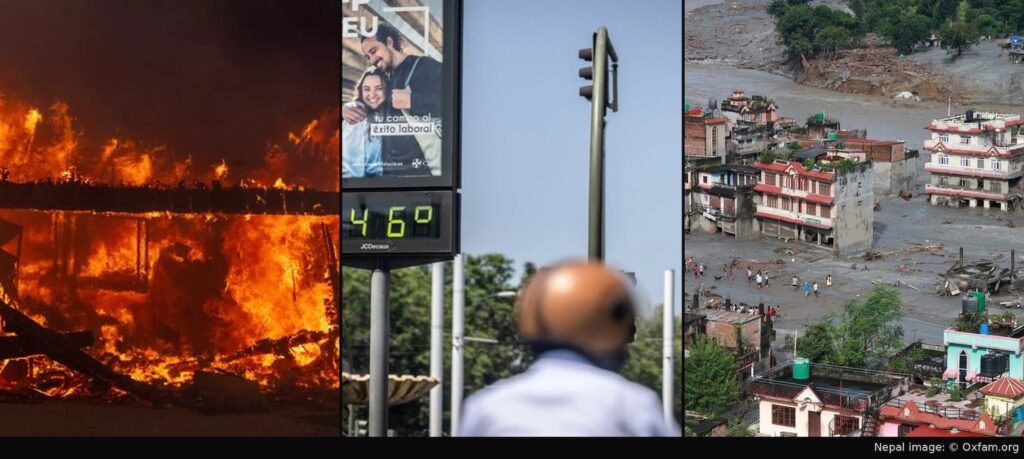
The Lever the Overshoot Report Didn't Name
UNEP says the height of the coming overshoot will be decided by how fast the world cuts methane, not by how much carbon it later removes. Coal mine methane, the fastest and cheapest cut on the table, is still not in the room.
On 2 September, UNEP published Limiting Overshoot — its first report to treat the breach of 1.5°C not as a risk to be prevented, but as a near-certainty to be managed. Under current policies, the report puts median warming at around 2.6°C by 2100. Under full delivery of every stated net-zero pledge, the best case is a peak of roughly 1.8°C before decline. The report's central argument is about that peak: how high it goes, and how long it lasts, will decide how much damage is locked in before the planet starts cooling back down.
Buried in that argument is a sentence that should have reordered a great deal of the current climate conversation. Reductions of short-lived gases — chiefly methane — can lower the rate of near-term warming and cap the peak itself; deeper cuts can also pull the post-peak trajectory down further. Carbon dioxide removal, by contrast, mostly acts on the tail — the slow return once the peak has already happened. Methane is currently responsible for roughly 0.5°C of today's warming, according to the IPCC's Sixth Assessment Report, and lasts nine to twelve years in the atmosphere against carbon dioxide's centuries — a lifetime short enough that, as UNEP's own report puts it, near-term methane cuts can “lower the peak” itself, not just the long-run average. If the peak is the variable that matters most, methane is the lever that moves it fastest.
The sector UNEP doesn't name
Read UNEP's own numbers on where that methane comes from, and one sub-sector disappears into the wallpaper. Oil and gas methane is treated as a rising problem to be solved. Agriculture gets its own chapter. Coal is folded into a generic “fossil fuels” category and, in UNEP and the Climate and Clean Air Coalition's own baseline projections, expected to stay roughly flat rather than fall. It only entered UNEP's satellite methane-alert system this May — years after oil and gas received dedicated tracking and its own international partnership framework. Coal mine methane is not being fought. It is being filed.
That baseline may already be out of date. Since March, the conflict between the United States and Iran has repeatedly disrupted the Strait of Hormuz, through which roughly a fifth of the world's LNG transits, and utilities across Asia and Europe have been turning back to coal wherever gas has become unaffordable or unreliable. Energy agencies have revised their coal forecasts upward more than once already this year, and with the conflict unresolved, nobody can say with confidence how large this resurgence will be or how long it will last. What can be said is that it is underway, that it is being driven by war and energy security rather than by climate policy, and that it is not reflected in the flat trajectory UNEP's own methane projections assume. A coal fleet moving in the wrong direction, by an amount nobody can yet quantify, makes a coal-specific crediting method more urgent, not less.
Ember's own coal mine methane programme director has put it more bluntly than we need to: the sector is overlooked twice over — methane is overlooked relative to carbon dioxide, and coal is overlooked relative to oil and gas within methane itself. That is not a fringe complaint. It is the assessment of the organisation that has spent the past four years telling regulators, in writing, that a coal-specific crediting method does not exist and needs to.
A hard ask, honestly put
We heard the clearest version of why, in June, from inside the environmental movement itself. In a conversation recorded during London's heatwave for this publication, Jonathon Porritt — a foundational figure of the British environmental movement for four decades — sat with Richard Mattus, the engineer behind the UNECE's own best-practice guidance on coal mine methane abatement, and agreed on the technical case without reservation. Then he named the reason nobody was acting on it.
“The environmental NGOs don't want to be connected to coal mining, and they're pretty suspicious about credits, about carbon markets in general. So it's a hard ask, let's be honest.”
— Jonathon Porritt
Days later, the House of Lords convened a stakeholder meeting on methane in the fossil fuel sector, coal named on the printed agenda alongside oil and gas. Across the recorded transcript, coal is mentioned once — a delegate noting that their country had switched from coal power to gas. No discussion of coal mine methane as a category. No discussion of the abatement technology Mattus has spent his career refining. The pattern Porritt described in a private conversation played out, in public, within the same fortnight.
The technology is not the obstacle
None of this is a story about missing engineering. Regenerative thermal oxidisers — the core abatement technology for ventilation air methane — are mature, proven at scale, and in places already commercially rational. Ember's own cost analysis puts VAM abatement at roughly AUD 26 per tonne of CO2-equivalent, against an Australian carbon credit price near AUD 30 — cheaper than the credits some mines already buy instead of abating. Where the case has been tested against real mine economics, in our own reporting from Australia, the barrier has consistently been financing and crediting design, not physics or engineering readiness.
What coal mine methane has lacked, since the UN's Clean Development Mechanism wound down roughly fifteen years ago, is a constituency with both the capital and the motive to fund it. Environmental NGOs, by their own account, won't campaign on it. Governments have been asked, repeatedly, to write the crediting methods that would make it pay for itself, and mostly haven't. Abatement investment on VAM typically pays back within five to six years — a mine does not need decades of remaining life to clear that bar, only more than a handful of years. Where that bar is cleared and the investment still isn't made, the constraint is not time, it is treatment: abatement remains a discretionary line item rather than a standard operating cost, the way safety compliance already is. And where a mine's remaining life genuinely falls short of the payback period, that changes who pays and how fast — it does not change the fact that the methane a working mine releases has to be abated.
The capital that is moving, and where
There is a candidate constituency now, and it is not funding this. The AI industry is deploying tens of billions of dollars into carbon removal to protect its own climate commitments — Microsoft alone holds roughly 80 percent of the global market for purchased carbon removal credits, and the largest hyperscalers together are estimated to need $70–80 billion in removal capacity to meet their targets. That capital is real, and it is being spent at a pace no climate NGO could match. None of it, in any market we have examined, has gone toward coal mine methane abatement specifically — the fastest, best-documented, and in places cheapest reduction available for the exact near-term warming variable this capital is nominally trying to address.
The model for redirecting even a fraction of it already exists, just aimed elsewhere. The Environmental Defense Fund has proposed that steel producers buying metallurgical coal should finance methane abatement at the mines that supply them, turning a buyer's balance sheet into the missing constituency a mine operator alone cannot be. There is no structural reason that logic stops at steel. A data centre operator's dependence on a coal-linked grid is, in financial terms, no different from a steelmaker's dependence on a coal mine — a large, capital-rich buyer sitting at the end of a supply chain whose upstream emissions it currently has no obligation, and little incentive, to trace.
What Porritt said would come next
At the close of our June conversation, Porritt made a prediction rather than an argument.
“There's going to be a reckoning, when a lot of these forest-based credits are seen not to have delivered the abatement that we were looking for. And then people are going to be looking around for a different understanding of what is meant by a gold standard credit.”
— Jonathon Porritt
Some of that reckoning is already visible in the integrity questions now surrounding forest and land-use credits in the very market Australian coal mines rely on to meet their own compliance obligations — questions this publication has covered directly. Porritt's argument was that when it lands in full, the market will go looking elsewhere for something it can actually trust. What it has not yet done is look toward coal mine methane.
On 2 September, UNEP's report told the world which lever caps the peak. It did not spend a single sentence on coal mine methane specifically to make that case — it didn't need to, because the physics holds regardless of which sector the methane comes from. What the report can't do is say who pays to cut it. That is exactly where Porritt's June prediction picks up. His forecast wasn't that environmental NGOs would suddenly take up coal — he was clear they wouldn't. It was that the market itself would eventually go looking for a credit it could actually trust — one verified at the meter, not modelled decades into the future. Coal mine methane abatement already meets that test, and for a simpler reason than credit design: it is not an accounting exercise. A tonne of methane destroyed at a mine shaft is a tonne that stops warming the planet immediately, measured at the point it happens, not projected, not modelled, not owing its validity to a forest that may not still be standing in thirty years. It sits outside UNEP's own sector priorities in September, just as it sat outside the room in June. Coal mine methane is not an unsolved problem; it is an unclaimed one — the technology proven, cheaper in places than the offset credits some mines already buy instead of abating, the science now stating plainly that near-term cuts matter most, and still, on every agenda that has had the chance to name it this year, absent.